
Why Your Ego Gets Triggered When Someone Corrects You
Dec 19, 2025
Have you ever been in a situation where someone corrects you — a teacher, a boss, even a friend — and instead of feeling grateful, you shut down? Maybe you get defensive, frustrated, or even give up completely.
You’re not alone.
This reaction is more common than you think, and it has less to do with the correction itself and more to do with what it awakens inside of us.
Why Correction Feels Like an Attack
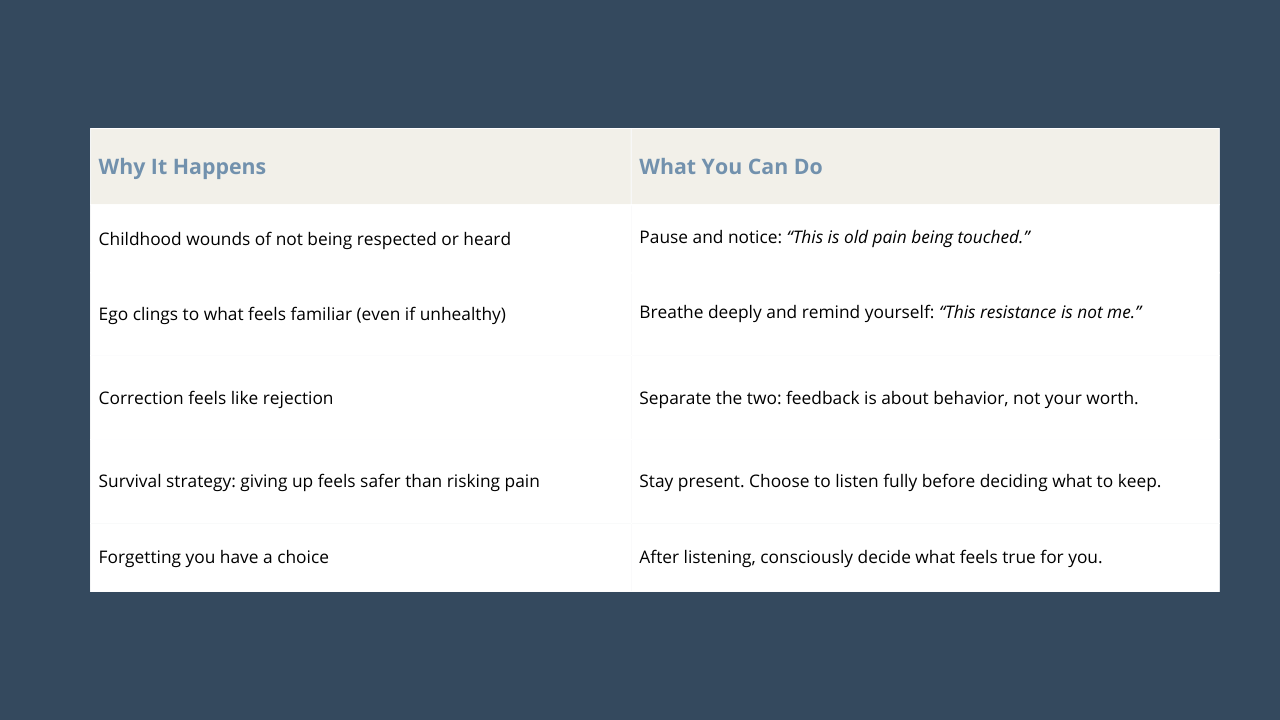
Our ego is built from patterns of survival. It prefers what feels safe, familiar, and known — even if that “known” isn’t truly healthy.
When someone corrects us, especially around behaviors or beliefs tied to our identity, the ego feels threatened. Instead of seeing the correction as help, it registers it as danger.
Correction often touches an old wound, not just the present moment.
Where This Wound Comes From
For many, the trigger of correction goes back to childhood or teenage years:
- Times we weren’t respected when sharing our feelings.
- Parents or teachers who criticized without listening.
- Moments of being neglected, silenced, or humiliated.
So when someone corrects us today, our body doesn’t just hear the words in front of us. It reactivates that old pain of not being seen, not being valued.
That’s why a small comment can feel overwhelming.
The Hidden Cost of “Giving Up”
Maybe you’ve noticed that after being corrected, you feel so frustrated that you just want to give up.
This reaction makes sense — it’s your nervous system trying to protect you from reliving old pain. But over time, it comes with a cost:
- You stop learning new skills.
- You avoid feedback that could help you grow.
- You start believing you’re “not good enough.”
Frustration and giving up aren’t signs of weakness — they’re signs of an unhealed wound asking for attention.
How to Work With It (Step by Step)
Next time you feel that surge of frustration when corrected, try this small practice:
-
Pause and Breathe
Notice the resistance rising. Instead of reacting, take one deep breath in… and out.
-
Name What’s Happening
Say silently to yourself: “This is resistance. This is frustration. It’s an old survival strategy — but it’s not me.”
-
Listen Fully
Commit to hearing exactly what the other person is saying. Don’t fight it yet — just listen.
-
Observe, Don’t Drown
Notice your feelings without being pulled under. You are the one observing, not just the one reacting.
-
Choose Your Response
After listening, you can decide: Does this correction help me? Does it reflect truth for me? You always have the choice.
Like any practice, this takes repetition. Day by day, you build the muscle of staying open instead of shutting down.
The Deeper Liberation
The real freedom comes when you realize: correction doesn’t define your worth.
It is just information, offered by another person. You get to choose what to do with it.
When you stop confusing correction with rejection, you step into a new kind of power — the power to learn, to grow, and to stay open without losing yourself.
Liberation is knowing: I can hear feedback, feel my emotions, and still choose my own truth.
Stay connected with news and updates!
Join our mailing list to receive the latest news and updates from our team.
Don't worry, your information will not be shared.
