
What We Lose When We Reduce Ourselves to Our Personality
Apr 29, 2026
Most people describe themselves through personality traits.
- “I’m anxious.”
- “I’m rational.”
- “I’m not emotional.”
- “I’ve always been like this.”
At first glance, this seems honest. Personality helps us make sense of ourselves and others. It gives us language, structure, and identity.
But there is a hidden cost when we believe our personality is the totality of who we are.
Much of human suffering does not come from what we feel or think, but from how tightly we identify with those patterns. When personality becomes fixed, it stops being a tool and turns into a limitation.
Personality Is a Function, Not an Essence
From a psychological point of view, personality is a set of patterns:
- emotional responses
- coping strategies
- learned behaviours
- survival mechanisms
These patterns are shaped early in life, influenced by family, culture, trauma, and environment.
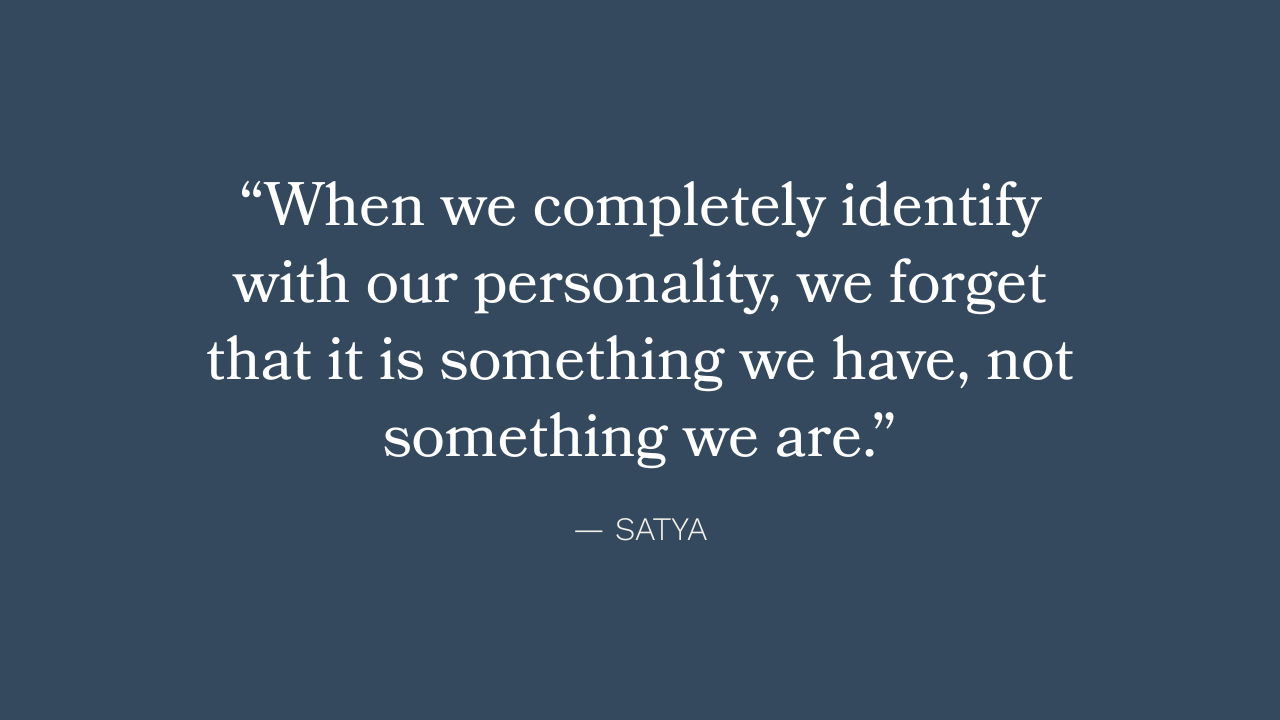
Personality helps us navigate the world. It allows us to function socially and make decisions. There is nothing wrong with having a personality.
The problem begins when personality becomes an identity rather than a function.
There is a clear distinction between:
- the persona (the adapted self that learned how to survive)
- and consciousness (the awareness that observes experience)
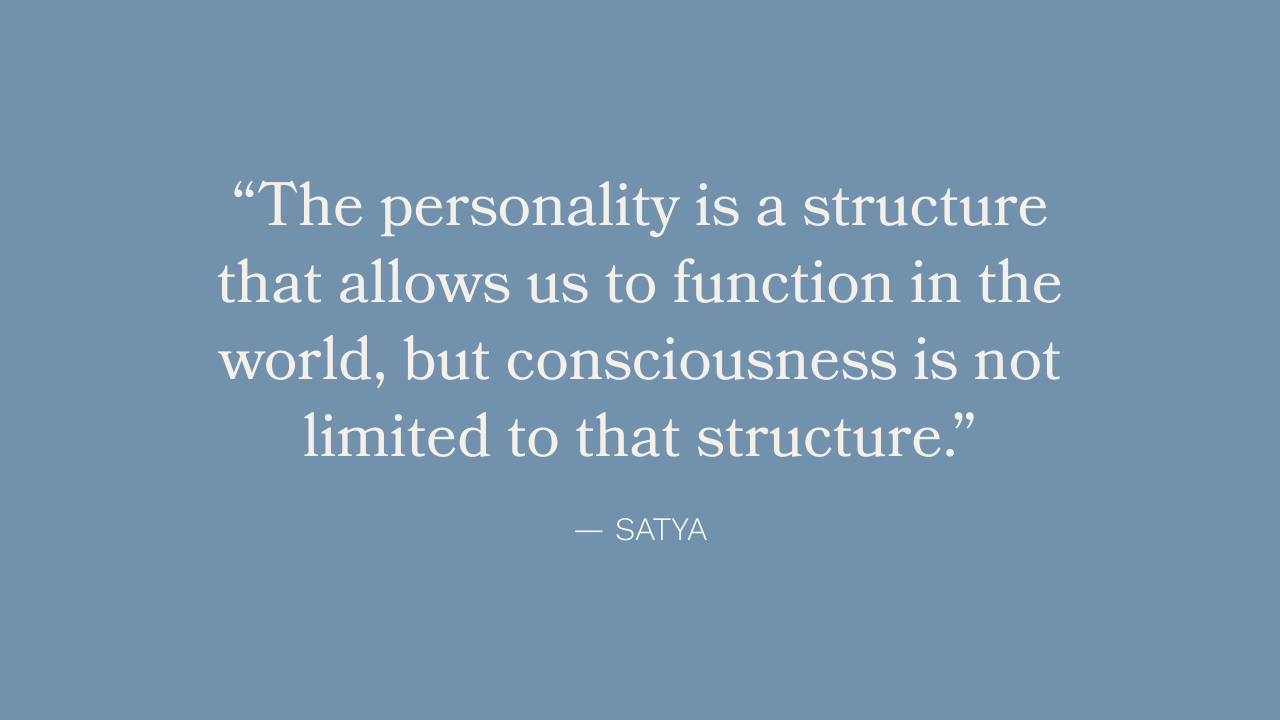
When we confuse the two, we start believing that our reactions are facts, our habits are truths, and our limitations are permanent.
How Personality Becomes a Cage
Most personality traits begin as intelligent adaptations.
- Someone who grew up in an unpredictable environment may become hyper-vigilant.
- Someone who learned that emotions were unsafe may become highly rational.
- Someone who was not seen may become constantly accommodating.
These traits once served a purpose.
But over time, they solidify.
When that happens, people stop asking:
- “Is this still serving me?”
- “Do I have another option?”
- “Is this response conscious or automatic?”
Instead, they say:
“This is just how I am.”
This sentence often marks the end of curiosity and the beginning of stagnation.
The moment we say ‘this is just who I am,’ we stop relating to ourselves as something alive and dynamic.
Personality and the Illusion of Freedom
One of the most subtle consequences of over-identification with personality is the illusion of choice.
- We believe we are choosing freely, but many of our decisions are actually predictable reactions.
- We enter similar relationships.
- We repeat familiar conflicts.
- We sabotage change at the same stage.
- Not because we want to, but because our personality structure feels safer than the unknown.
“Most people are not acting from freedom. They are reacting from conditioning.”
When personality is unconscious, it runs the system.
When it is observed, it becomes flexible.
The Observer: What Is Missing From Personality
The observer is the capacity to notice:
- “I am feeling anger” instead of “I am angry”
- “I am having this thought” instead of “this thought is me”
This distinction may sound small, but its impact is profound.
The observer creates space between experience and identity.
“When the observer is present, emotions and thoughts stop defining who we are.”
Without the observer:
- emotions feel overwhelming
- reactions feel inevitable
- change feels threatening
With the observer:
- emotions can be felt without becoming them
- thoughts can be questioned
- personality becomes something we can work with, not defend
Why Personality Feels So Heavy
Many people describe feeling “stuck,” “heavy,” or “tired of themselves.”
This is often interpreted as depression, lack of motivation, or failure.
But it can also be understood differently.
When we carry a personality as an identity, we are constantly maintaining it:
- defending it
- justifying it
- protecting it
- repeating it
This maintenance is exhausting.
“Identifying with the personality takes a lot of energy, because it needs constant reinforcement.”
The system tightens. Life becomes repetitive. Creativity diminishes. Relationships lose freshness.
Not because life is empty, but because experience is filtered through the same narrow lens.
Trauma, Personality, and Survival Identity
Trauma plays a significant role in how personality solidifies.
“Trauma is not what happened. Trauma is how the system reacted to what happened.”
When an experience overwhelms the nervous system, the personality reorganises around survival.
This can lead to identities such as:
- “the strong one”
- “the rational one”
- “the independent one”
- “the one who never needs help”
These identities may look functional, even admirable. But they often come at the cost of emotional range, intimacy, and flexibility.
Letting go of them can feel dangerous, because they once protected us.
That is why people cling to personality even when it hurts.
What We Lose in Relationships
When personality is rigid, relationships suffer quietly.
- We stop meeting people as they are.
- We meet them through our patterns.
- Conflict becomes predictable.
- Roles become fixed.
- Curiosity fades.
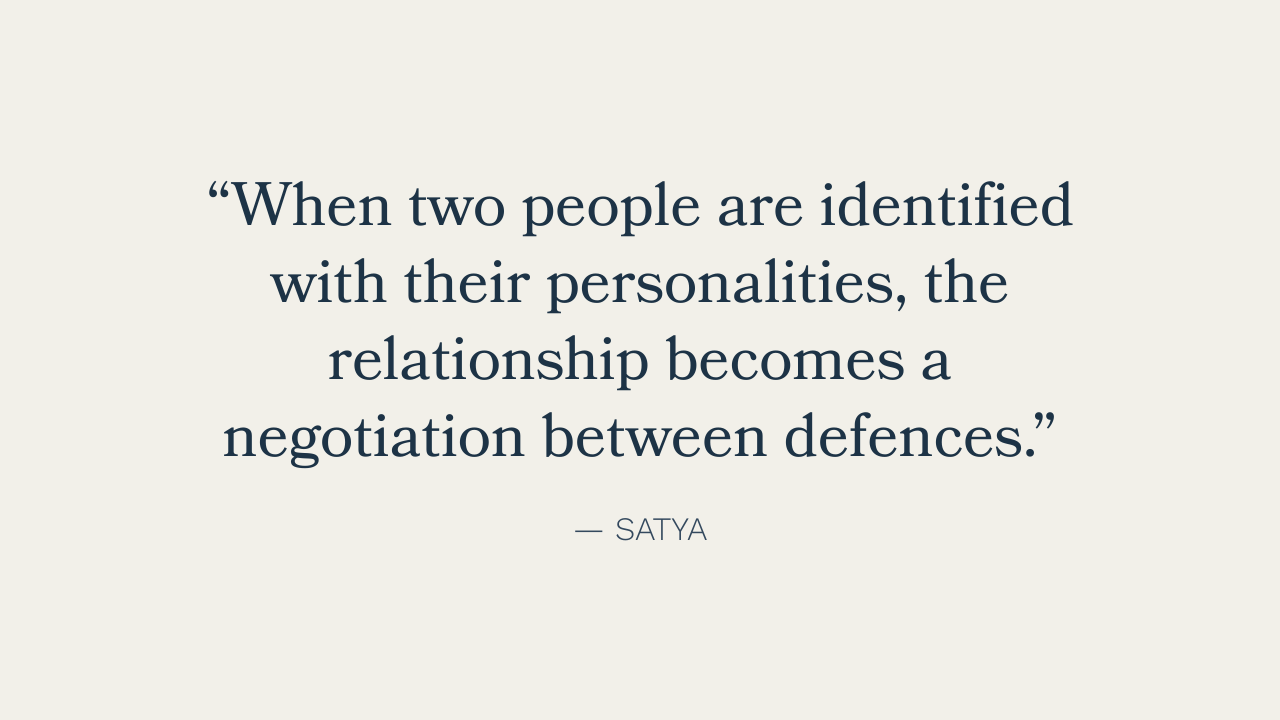
Many relational struggles are not about incompatibility, but about two personalities defending themselves.
The observer allows something else to emerge:
- listening without preparing a response
- feeling without needing to win
- disagreeing without threatening identity
Without it, relationships stay stuck in repetition.
Awareness Is Not the Destruction of Personality
An important clarification: awareness does not mean eliminating personality.
The goal is not to erase personality, but to relate to it differently.
“The personality does not need to disappear. It needs to be seen.”
When seen, it softens.
When softened, choice appears.
You may still be sensitive.
You may still be analytical.
But these traits stop being prisons.
They become tools.
From Identity to Experience
Perhaps the most profound shift Satya points to is this:
Moving from being someone to having experiences.
When identity loosens, life becomes experiential again.
Less about protecting who we think we are.
More about responding to what is actually happening.
This does not make life easier.
But it makes it more honest.
And, paradoxically, more alive.
Closing Reflection
Reducing ourselves to our personality may feel safe, but it is costly.
We lose:
- flexibility
- depth
- freedom
- genuine connection
What we gain in predictability, we lose in possibility.
Awareness does not ask us to become someone else.
It asks us to stop believing we are only one thing.
“Freedom begins when we realise that what we experience is not the same as who we are.”
Stay connected with news and updates!
Join our mailing list to receive the latest news and updates from our team.
Don't worry, your information will not be shared.
