
What Most People Get Wrong About Altered States of Consciousness
May 20, 2026
Altered states of consciousness tend to provoke extreme reactions.
- Some people see them as shortcuts to healing, insight, or awakening.
- Others dismiss them entirely as hallucinations, fantasies, or neurological accidents.
- Both views miss the point.
Altered states are neither magical solutions nor meaningless brain malfunctions. They are shifts in how consciousness is experienced and organised, and their value depends almost entirely on context, preparation, and integration.
“An altered state is not a fantasy. But it is also not a solution by itself.”
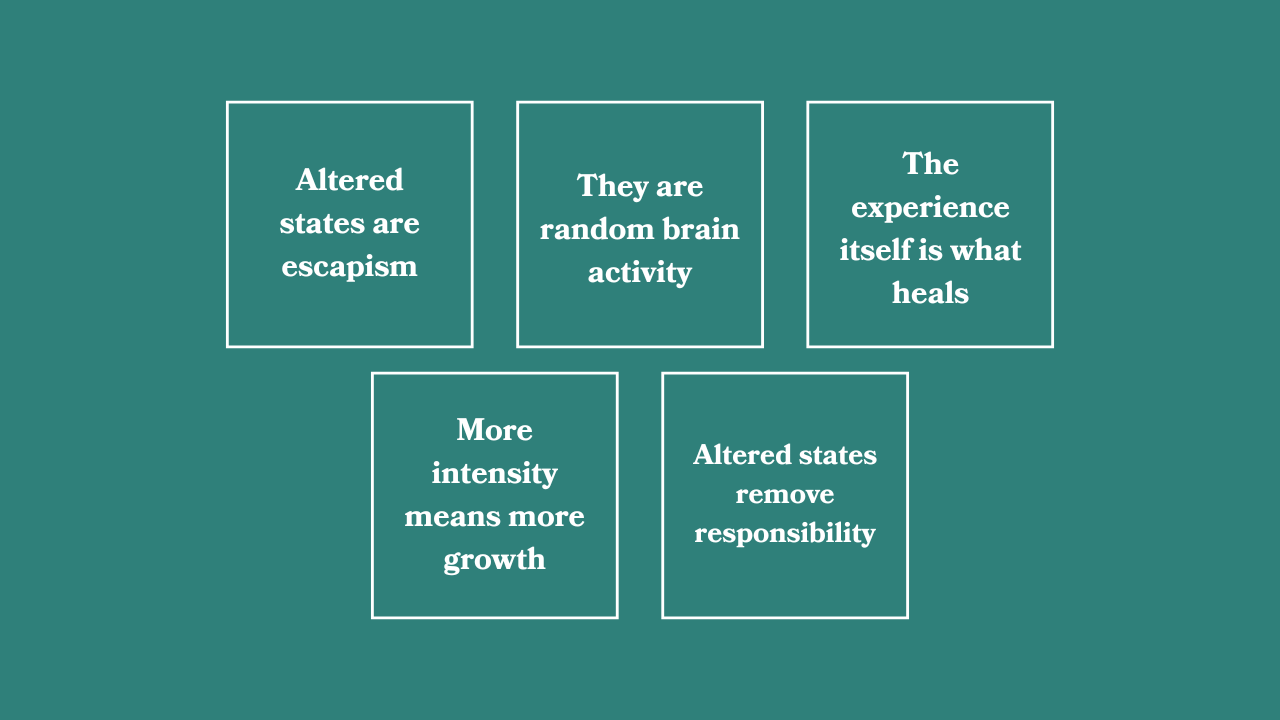
Misconception 1: Altered states are escapism
One of the most common assumptions is that altered states are about escaping reality.
Altered states often do the opposite. Rather than offering escape, they bring people into contact with:
- avoided emotions
- unresolved grief
- internal contradictions
- suppressed memories
“Most people don’t escape in altered states. They meet what they’ve been avoiding.”
The difficulty is not that these states remove us from reality, but that they can expose parts of reality we prefer not to face.
Misconception 2: They are random brain activity
Another widespread belief is that altered states are simply neurons firing chaotically, producing meaningless images and sensations.
The brain does not distinguish between what is externally real and what is internally experienced. What the brain perceives as real produces real physiological and emotional effects.
This is already evident in everyday life:
- imagined danger can trigger panic
- memories can activate the body
- visualisation can change behaviour
“For the brain, experience is reality. Whether it comes from the outside or the inside.”
If altered states were purely random, they would not lead to lasting emotional, behavioural, or physiological changes. Yet, when approached responsibly, they often do.
Misconception 3: The experience itself is what heals
Many people focus on the intensity of the experience.
- How strong it was.
- How emotional it felt.
- How much was seen or understood.
This focus is misplaced.
"The experience alone does nothing. It’s what you do with it that changes your life.”
Without reflection, grounding, and follow-up, even the most powerful experiences fade. Insight does not automatically translate into change.
What matters is:
- how the experience is processed
- how it is understood
- how it is integrated into daily life
Without this, altered states become memories, not transformation.
Misconception 4: More intensity means more growth
Another common misunderstanding is the belief that deeper, stronger, or more frequent altered states automatically lead to growth.
This mindset often turns inner work into consumption.
Depth is not measured by how far consciousness travels, but by how life changes afterward.
Real growth is often quiet:
- different choices
- healthier boundaries
- more honest relationships
- greater emotional responsibility
These changes rarely look dramatic, but they are far more meaningful.
Misconception 5: Altered states remove responsibility
Some people unconsciously hope that altered states will solve problems for them.
This expectation leads to disappointment.
Altered states tend to increase responsibility, not remove it. They can highlight patterns that require action, not contemplation.
“An altered state doesn’t take responsibility away. It often gives you more of it.”
What follows insight is often uncomfortable:
- ending unhealthy dynamics
- changing habits
- grieving losses
- facing difficult truths
Without willingness to do this work, insight remains theoretical.
Why fear often appears in altered states
Fear is a common experience during altered states, and it is often misinterpreted as something going wrong.
Fear usually arises when:
- control loosens
- identity softens
- familiar reference points dissolve
The nervous system reacts to this loss of control as danger.
“The fear is usually not about what’s happening. It’s about losing what feels familiar.”
With proper preparation and support, this fear can be navigated. Without it, it can overwhelm the system.
Context shapes everything
Perhaps the most important point Satya makes is that there is no such thing as a neutral altered state.
Context determines whether an experience is:
- stabilising or destabilising
- clarifying or confusing
- supportive or harmful
Context includes:
- the environment
- the people involved
- the level of safety
- what happens afterward
“Context shapes everything. The same experience in a different context can have a completely different effect.”
This is why preparation and integration are essential, not optional.
Altered states are not rare or exotic
Another misconception is that altered states are unusual.
In reality, people enter mild altered states regularly:
- when deeply focused
- when moved by music
- when time seems to disappear
- when fully present
These moments show that consciousness is flexible by nature.
The question is not whether altered states exist, but how we relate to them.
Altered states of consciousness are not shortcuts, escapes, or illusions.
They are shifts in perception that can reveal important information, but only when held with responsibility.
Without grounding and integration, nothing truly changes.
“An altered state can open a door. Walking through it is a different process.”
Stay connected with news and updates!
Join our mailing list to receive the latest news and updates from our team.
Don't worry, your information will not be shared.
