
Therapy Makes Sense, But Life Still Doesn’t (Why You Feel the Same)
Jun 03, 2026
Therapy helped me understand myself.
It gave me language, context, and clarity.
And still, something didn’t change.
- I could explain my story.
- I could name my trauma.
- I could see my patterns.
Yet my reactions stayed familiar.
My body stayed tense.
Certain relationships kept repeating the same dynamics.
If this sounds familiar, you’re not failing therapy.
You’re touching its limits.
“Sometimes therapy isn’t enough. Not because it doesn’t work, but because some wounds live deeper than words.”
Therapy gives awareness. Awareness is not the same as change.
Therapy is essential. I value it deeply.
It gave me words for experiences that once felt chaotic and isolating.
It helped me recognise:
- where my fears come from
- how my childhood shaped my reactions
- why certain situations trigger me
That matters.
But at some point, many people arrive at a quiet, confusing place.
They think:
“I understand all this… so why am I still here?”
Insight explains the problem. It doesn’t automatically transform it.
When understanding stays in the mind
Most therapy works primarily with the mind.
With memory, narrative, interpretation.
And for many wounds, that’s the necessary first step.
But some experiences live deeper than words.
Trauma doesn’t only exist as a story.
It exists as sensation, tension, impulse, shutdown.
The body remembers what the mind already understands.
That’s why you can know you’re safe…
and still feel unsafe.
You can know you’re loved…
and still brace for abandonment.
You can know you’ve forgiven…
and still freeze when the person enters the room.
“Why do I keep reacting if I know better?”
This question comes up again and again.
And the answer is uncomfortable, but honest:
- Because knowing is not the same as being regulated.
- Because insight doesn’t automatically reach the nervous system.
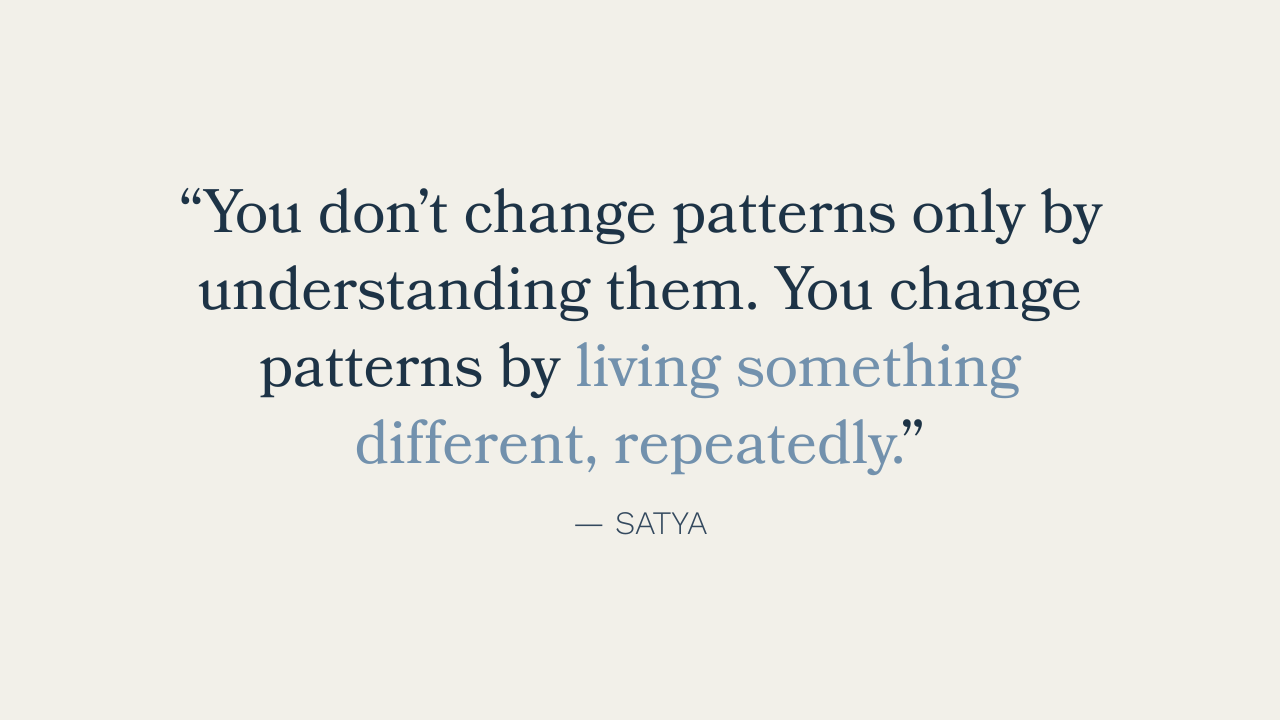
That takes time, presence, and conditions that go beyond talking.
Therapy was never meant to carry everything alone
Somehow, we turned therapy into the place where everything should be solved.
If it doesn’t work fully, we assume:
- we chose the wrong therapist
- we’re too complex
- or something is wrong with us
But therapy was never designed to hold the full weight of healing by itself.
It’s a foundation.
Not the whole house.
When life still doesn’t change, it’s often because healing is asking to move:
- from explanation into experience
- from insight into embodiment
- from isolation into relationship
Therapy is not the destination. It is the bridge.
Healing doesn’t happen only in reflection. It happens in contact.
Real change happens in moments where:
- the body feels something new
- a reaction is interrupted by presence
- a relationship feels safe enough to be honest
- an emotion is allowed instead of managed
These moments rarely happen only by talking about them.
They happen in lived situations:
- with others
- in the body
- in real time
Healing asks to be lived, not only understood.
When therapy becomes a loop
There is a point where therapy can unintentionally reinforce the story.
We revisit the same memories.
We analyse the same dynamics.
We understand more and more.
But life stays the same.
At that point, the question changes.
Not:
“What happened to me?”
But:
“How am I living now, because of what happened?”
That shift is subtle.
And essential.
“We remain on the level of the personality structure, and we keep working there, even when something deeper is asking to be lived.”
The missing pieces people rarely talk about
When therapy “works” but life still doesn’t move, what’s often missing is not effort.
It’s integration.
Integration means:
- the body is included
- emotions are felt, not only explained
- relationships become part of the healing field
- meaning is questioned, not assumed
Many people don’t need more insight.
They need different conditions to live differently.
This is not a failure. It’s a threshold.
If you’re here, feeling this gap, it doesn’t mean therapy didn’t work.
It means it worked enough to bring you to the next layer.
A layer where the questions become deeper:
- Who am I beyond my story?
- How do I want to live now?
- What does “being well” actually mean for me?
These are not questions therapy alone can answer.
They are lived questions.
If therapy makes sense but life still doesn’t, pause before blaming yourself.
Listen to what that frustration is pointing to.
Often, it’s not asking for more understanding.
It’s asking for a different way of being in your life.
And that moment, uncomfortable as it is, is not the end of healing.
It’s where it actually begins.
Stay connected with news and updates!
Join our mailing list to receive the latest news and updates from our team.
Don't worry, your information will not be shared.
