
“Why Can’t You Be More Like Your Sister?” How Comparison Starts in Childhood
Feb 11, 2026
Many adults carry a familiar sentence inside them, even if no one says it anymore.
Why can’t you be more like her?
Why isn’t this easy for you?
Why don’t you try harder?
Sometimes the words were spoken directly.
Sometimes they were implied through looks, silence, or praise given elsewhere.
And sometimes, no sentence was ever spoken at all. Yet the child still learned something very clearly: who I am is not enough.
Comparison does not begin on social media.
It does not begin at work.
It does not begin in adulthood.
For most people, comparison begins in childhood, inside the place where love should have felt unconditional.
Comparison is often born in love, not cruelty
This is important to say clearly.
Most parents do not compare their children because they want to harm them. They do it because they are afraid. Afraid their child will not succeed. Afraid the world will be too harsh. Afraid life will not be kind.
So comparison becomes a tool.
A misguided attempt to motivate.
A way to push a child forward.
A way to say, I want more for you, without knowing how to say it differently.
But the child does not hear motivation.
The child hears meaning.
And the meaning often sounds like this:
If I am myself, I am not enough.
If I behave differently, I might be loved more.
No parent does this consciously. They truly believe they are doing the best they can.
And still, something breaks quietly inside the child.
The moment comparison changes love into performance
Children do not yet have the capacity to analyze behaviour. They feel it.
When a child is compared to a sibling, a cousin, a classmate, or a neighbour, something subtle happens inside:
- Love stops feeling like a given.
- Love starts to feel earned.
- Approval becomes linked to behaviour.
- Belonging becomes linked to performance.
The message the child receives is that approval, love, and belonging start to depend on performance.
This is not a conscious choice by the child. It is a survival adaptation.
The child learns to adjust, to behave, to suppress parts of themselves that are not welcomed. Over time, they stop asking what do I feel? and start asking what is expected of me?
And slowly, the original self moves into the background.
Sibling comparison and the fear of losing love
Sibling comparison is one of the most common ways this pattern begins.
Not because siblings are enemies, but because children are deeply sensitive to attention.
When a parent says or implies that one child is “better,” “easier,” “more successful,” or “more responsible,” the other child does not simply feel disappointed.
They often feel endangered.
Children depend on caregivers for survival. So comparison can register as a threat: If I am not enough, will I lose love? Will I lose my place?
“Envy often comes from the fear of losing love, attention, or belonging.”
This fear can arise when:
- a sibling is praised more
- a sibling needs more care due to illness
- parents separate and form new families
- one child is seen as “the problem” and another as “the example”
The child does not think in adult logic. They feel in absolutes.
If I am not chosen, I disappear.
When parents compare because they don’t know how to inspire
Many adults were raised by parents who themselves grew up with comparison.
They learned that success means being better than others. That recognition comes from standing above, not from standing in truth.
So when they compare their children, they are repeating a system they never questioned.
Many parents don’t know how to inspire in a way that is respectful to the child’s essence.
Instead of asking who is this child?, comparison asks why aren’t you like someone else?
And the child learns to leave themselves in order to belong.
What happens inside the child
- Internally, the child begins to split.
- There is who they are.
- And there is who they believe they must be.
- The authentic feelings, impulses, and needs start to feel risky. So they are pushed down.
So the child starts to behave in a certain way and then identifies with the behaviour. Authentic feelings become repressed.
This is how personality structures are born.
Not because the child is fake.
But because the child is trying to survive.
How childhood comparison becomes adult self-doubt
Years later, the child grows up.
From the outside, they may look capable, successful, independent, even confident.
Inside, many adults carry a quiet confusion:
- I don’t really know who I am.
- I don’t trust what I feel.
- I’m always waiting for approval.
- Nothing I do ever feels like enough.
Many adults arrive to us saying, ‘I don’t know who I am because I behaved my whole life to fulfill expectations.
This is the long shadow of childhood comparison.
The adult may continue comparing themselves at work, in relationships, in friendships. Not because they want to compete, but because their nervous system learned early that worth is relative.
Two common adult adaptations
From childhood comparison, two main adult patterns often emerge.
The overachiever
This person tries to secure worth through achievement.
They do more. They push harder. They rarely rest. Praise becomes fuel, and silence becomes panic.
Their question is: Am I enough now?
The withdrawer
This person avoids visibility.
They don’t try fully. They stay in the background. They protect themselves from criticism by not risking exposure.
Their question is: What if I try and still fail?
Both patterns come from the same root.
A child who learned that being themselves was not safe.
Why this creates relationship difficulties
When someone grows up performing for love, intimacy becomes complicated.
True closeness requires being seen.
But being seen once felt dangerous.
So adults may:
- struggle to express needs
- avoid conflict
- hide vulnerability
- stay in relationships where they are not fully respected
- feel lonely even with others
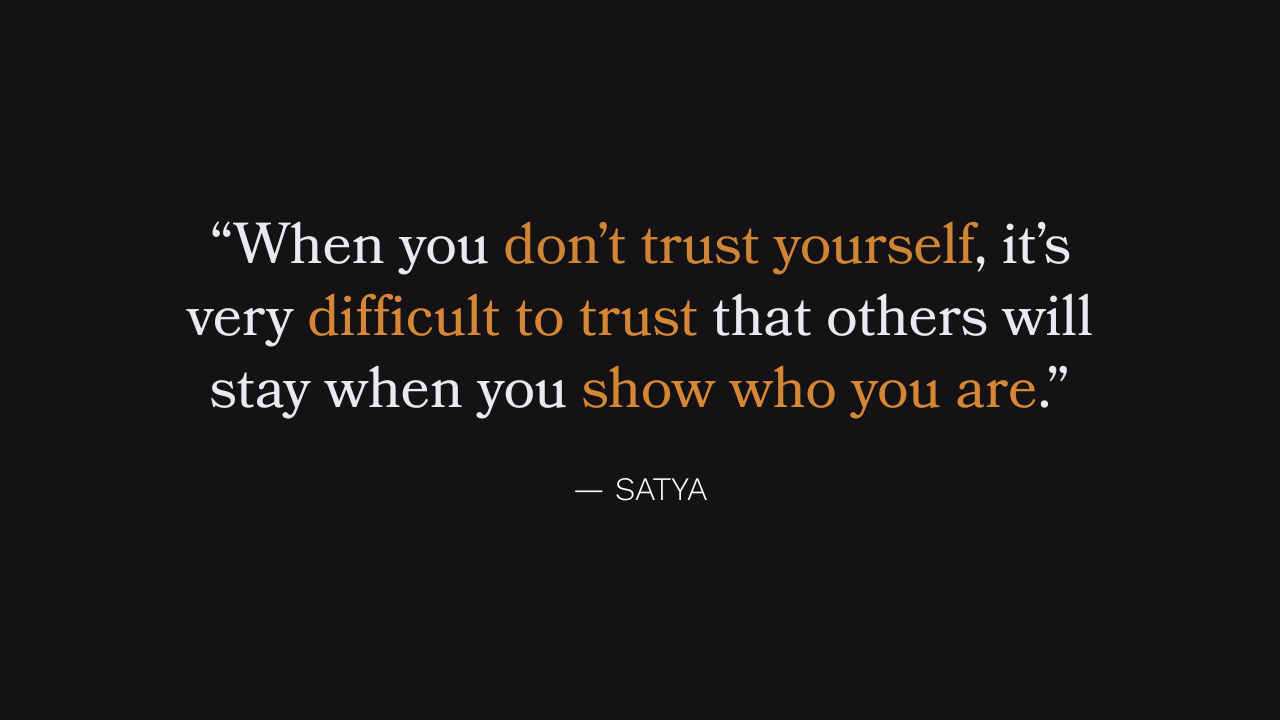
This is not a flaw. It is a learned protection.
Healing does not mean blaming parents
This is a crucial point.
Healing this pattern does not mean turning against parents or reliving anger endlessly.
This is not about going against your parents. It’s about understanding they did what they could, and now you have the responsibility to come back to yourself.
Many people need a phase of distance to reclaim themselves. This is natural. Over time, when responsibility replaces blame, compassion can grow.
Not forced compassion. Real compassion.
Seeing parents as human beings, not authorities.
Coming back to yourself as an adult
Healing childhood comparison begins with honesty.
Not dramatic confrontation.
Not fixing yourself.
Not becoming “better.”
But asking different questions:
- What did I learn about love?
- Where did I stop trusting myself?
- Which parts of me did I hide to belong?
The moment you start listening to your authentic needs, your adult self becomes trustworthy again.
This is a gradual process.
Each time you choose honesty over performance, something softens.
Each time you notice comparison without judging yourself, something untangles.
A gentle reflection
You might sit with these questions, without forcing answers:
- In my family, who was I compared to?
- What did I learn about love from that comparison?
- What part of me did I hide to be accepted?
- How does this still show up in my adult life?
There is no rush.
These patterns took years to form. They deserve patience.
A closing thought
Comparison begins in childhood, but it does not have to rule adulthood.
The moment you recognize that your worth was never meant to be measured, something shifts.
Not all at once.
Not dramatically.
But quietly.
And in that quiet, a new relationship with yourself begins.
One where love is no longer earned.
One where belonging starts inside.
Stay connected with news and updates!
Join our mailing list to receive the latest news and updates from our team.
Don't worry, your information will not be shared.
