
How to Build Real Trust with Teenagers
Mar 11, 2026
If you have a child between 12 and 17, there is a moment that almost always arrives.
They look at you and say, with full conviction:
- “You know nothing.”
- “You are wrong.”
- “You don’t understand.”
For many parents, this moment feels like failure. Like disconnection. Like the beginning of distance.
But this phase is not a problem to fix.
It is a developmental threshold.
And how you respond to it will strongly influence whether your teenager keeps coming to you, or slowly stops talking at all.
Adolescence is not rebellion. It’s differentiation.
One of the biggest mistakes parents make with teenagers is interpreting their behavior as disrespect or rejection.
In reality, adolescence is the phase where a child must separate psychologically from their parents in order to become themselves.
- They question authority.
- They challenge ideas.
- They test limits.
- They align more with peers.
This is not pathology. It is development.
“This is the age where your teen will tell you that you know nothing. And that is natural.”
The danger does not lie in disagreement.
The danger lies in how disagreement is handled.
Why trust matters more than obedience
Many parents focus on rules, discipline, and control, believing that this is what keeps teenagers safe.
But rules alone do not protect teenagers.
Relationship does.
If a teenager feels emotionally safe with their parents, they are far more likely to:
- share doubts and fears
- talk about peer pressure
- ask for help when something goes wrong
- pause before engaging in risky behavior
If they do not feel safe, they don’t stop having problems. They simply stop bringing them home.
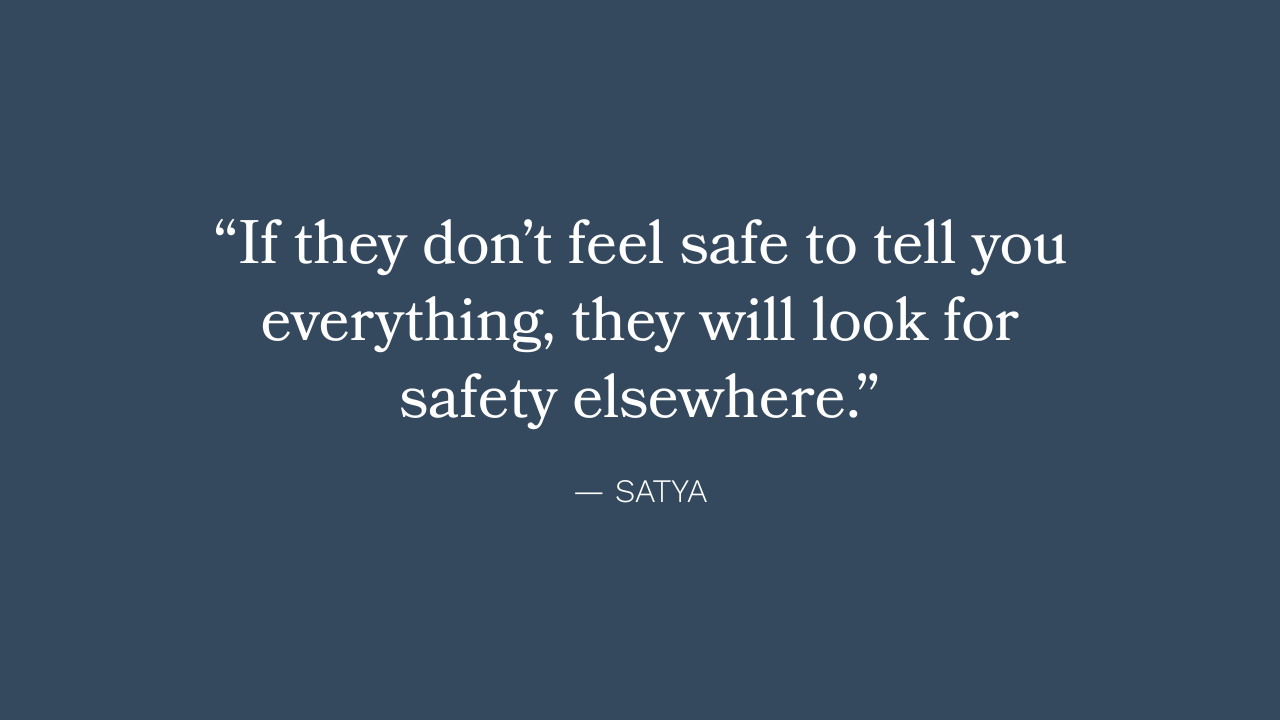
And “elsewhere” is not always a safe place.
The real risk is silence, not disagreement
Many parents fear losing authority.
But what truly puts teenagers at risk is silence.
Silence about:
- drugs
- sex
- mental health
- unsafe relationships
- shame
- mistakes
Teenagers don’t hide because they are bad or manipulative.
They hide because they are afraid of judgment, punishment, or emotional reactions they can’t manage.
Trust is not built by demanding honesty.
It is built by being able to receive honesty.
The difference between fighting and explaining
When teens challenge parents, many adults react by fighting back.
- They raise their voice.
- They impose authority.
- They dismiss the teen’s perspective.
This often escalates power struggles. “You don’t fight with them. You explain to them.”
Explaining does not mean convincing.
It means sharing perspective without humiliation, threat, or domination.
It sounds like:
- “I hear that you see it differently.”
- “I may not agree, but I want you to understand why I care.”
- “My role is to protect you, not to control you.”
This builds respect without breaking connection.
Why teens need to feel safe even when you disagree
One of the most important messages a parent can give a teenager is this:
“You can come to me even if I don’t agree with your choices.”
“Even if I don’t agree and maybe I will be mad, you can come to me.”
This sentence creates safety.
Not permissiveness.
Not approval of harmful behavior.
But relational security.
It tells the teenager:
- I won’t abandon you when things get difficult.
- My love is not conditional on your behavior.
- You don’t have to face consequences alone.
This is what keeps communication alive.
Protection is not control
Many parents confuse protection with control.
Control tries to prevent mistakes by restricting freedom.
Protection tries to prepare a teenager to navigate reality safely.
Control says: Don’t do this.
Protection says: If this happens, come to me.
“My role is not to control you. My role is to protect you.”
- Teenagers who feel controlled often rebel secretly.
- Teenagers who feel protected are more likely to pause, reflect, and reach out.
Why teens turn to risky behavior
Teenagers don’t usually turn to drugs, destructive behaviors, or unsafe groups because they want danger.
They do it because they are looking for:
- belonging
- understanding
- relief
- validation
If they don’t find these at home, they will search elsewhere.
This is not about being a “bad parent.”
It’s about emotional availability.
Trust is built before problems arise
One of the biggest misconceptions about trust is that it can be created in moments of crisis.
In reality, trust is built in ordinary moments:
- how you react when your teen disagrees
- how you respond when they challenge your ideas
- how you handle your own frustration
- how often you listen without correcting
By the time a serious issue appears, the relationship is already set.
Either your teen knows they can come to you, or they don’t.
What breaks trust quickly
Some common behaviors that unintentionally break trust with teens:
- mocking their opinions
- minimizing their feelings
- reacting with panic or anger
- interrogating instead of listening
- using their honesty against them later
Even well-intentioned reactions can teach a teen: It’s safer not to talk.
Trust doesn’t disappear all at once.
It erodes slowly.
What actually builds trust
Trust grows when teenagers experience consistency.
They need to see that:
- disagreement doesn’t lead to rejection
- mistakes don’t lead to humiliation
- emotions don’t overwhelm the parent
- conversations don’t turn into lectures
Practical trust-building behaviors include:
- listening fully before responding
- acknowledging their perspective even when you disagree
- explaining your concerns calmly
- staying available after conflict
- repairing when you overreact
Trust is relational, not instructional.
You don’t need to be perfect
Many parents believe they must always respond correctly.
This is not true.
What matters more than perfection is repair.
If you react badly, you can say:
- “I was too reactive earlier.”
- “I didn’t listen well.”
- “I want to understand you better.”
These moments often build more trust than getting it right the first time.
They show your teen that relationships can survive tension.
A realistic view of authority
Teenagers don’t need parents who try to be their friends.
They also don’t need parents who rule through fear.
They need adults who can hold authority without intimidation.
Authority rooted in care sounds like:
- “I’m responsible for your safety.”
- “I have more experience.”
- “I may see risks you can’t see yet.”
But it is paired with listening, not control.
Reflection for parents
You might reflect on these questions:
- How do I react when my teen challenges me?
- Do they feel safer telling me the truth or hiding it?
- Can I tolerate disagreement without taking it personally?
- What message am I giving when they make mistakes?
These questions are not about blame.
They are about awareness.
Teenagers don’t stop talking because they don’t care.
They stop talking when they don’t feel safe.
Building trust with teens is not about winning arguments or enforcing control.
It’s about creating a relationship strong enough to hold disagreement, mistakes, and growth.
“The most important thing is to create a relationship where they can tell you anything.”
That relationship is built now, not later.
And it becomes the foundation that protects them long after adolescence ends.
Stay connected with news and updates!
Join our mailing list to receive the latest news and updates from our team.
Don't worry, your information will not be shared.
