
What Artificial Intelligence Is Teaching Us About Being Human
May 13, 2026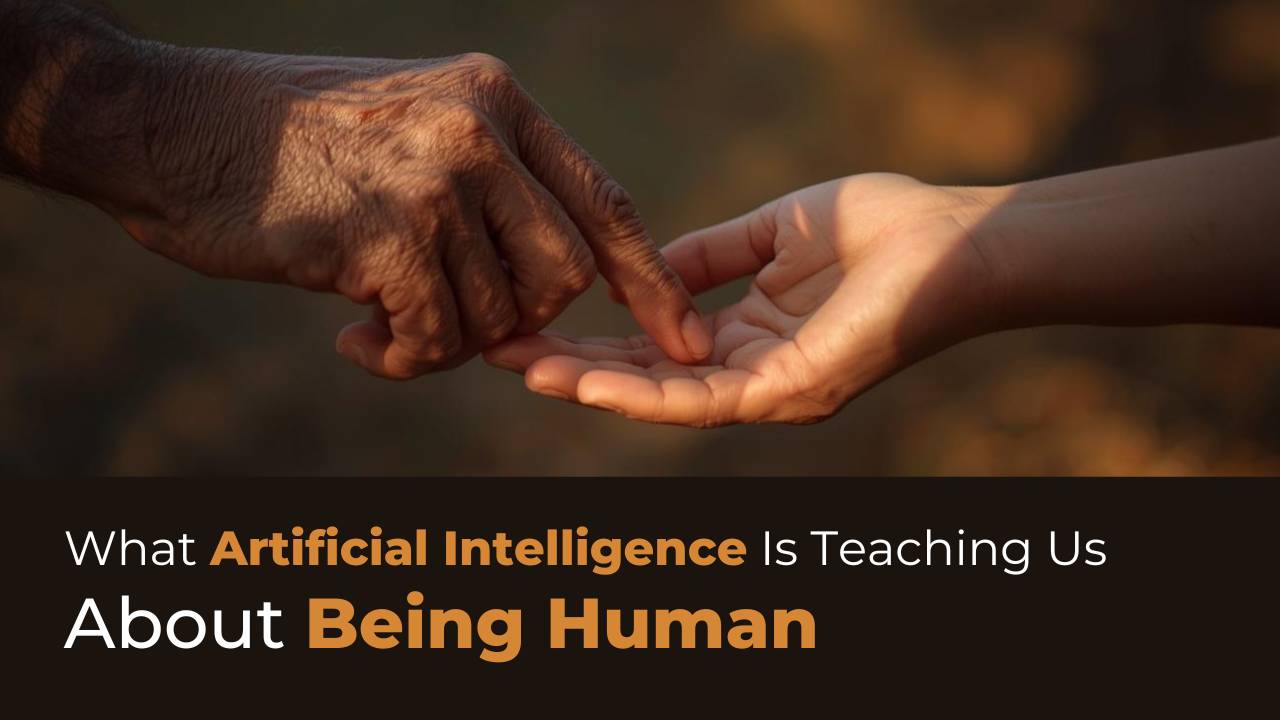
Why AI is not just a technological question
Artificial intelligence is usually discussed in terms of efficiency, speed, and innovation.
- How fast it learns.
- How much it can replace.
- How productive it can become.
But beneath these conversations lies a deeper question that we rarely pause to ask: what do we actually mean by intelligence?
AI has become a mirror. Not because it is conscious, but because it reflects how narrowly we have defined intelligence for a long time.
When intelligence is reduced to processing speed, optimisation, and output, machines will inevitably outperform humans. And when that happens, we begin to question our own value.
Intelligence is not consciousness
AI can analyse patterns, store enormous amounts of data, and produce sophisticated responses. None of this implies awareness.
There is a fundamental difference between processing information and experiencing life.
- Intelligence is the capacity to calculate, predict, and optimise.
- Consciousness is the capacity to feel, to suffer, to wonder, to care.
An intelligent system can calculate without ever knowing what it means to exist.
This distinction matters, because when we confuse intelligence with consciousness, we start measuring ourselves against the wrong standard.
Why humans start judging themselves like machines
One of the most subtle effects of AI is how it changes the way humans relate to themselves.
- Productivity becomes a measure of worth.
- Speed becomes a virtue.
- Efficiency becomes an expectation.
This did not start with AI. AI simply makes it more visible.
We trained machines to perform in a certain way, and now we apply the same criteria to ourselves. When we do that, human qualities such as vulnerability, slowness, emotional depth, and uncertainty start to look like weaknesses instead of essential aspects of being alive.
What AI reveals about human limits
AI excels where humans are limited.
- It does not get tired.
- It does not hesitate.
- It does not doubt itself.
This contrast can provoke fear, especially when people feel replaceable or inadequate.
But limits are not failures. They are part of what makes human life meaningful.
Being limited means:
- needing others
- making ethical choices
- feeling the consequences of actions
- learning through relationship and time
AI shows us where we are limited, and at the same time, where we are irreplaceable.
Consciousness cannot be automated
There is a common assumption that if systems become complex enough, consciousness will eventually emerge.
I approach this idea with caution.
Machines can simulate language, empathy, and creativity. Simulation, however, is not experience.
- No system feels loss.
- No algorithm carries grief.
- No machine takes responsibility for the impact of its actions.
These capacities are not technical achievements. They arise from being embodied, relational, and vulnerable.
Responsibility is the missing element
- AI does not take responsibility. Humans do.
- Technology does not decide how it is used. People do.
- As AI becomes more powerful, responsibility does not decrease. It increases.
Every decision about how AI is designed, deployed, and regulated reflects human values. Avoiding this responsibility by blaming technology is one of the greatest risks of our time.
Why AI challenges our sense of identity
Many people feel unsettled by AI not because of what it can do, but because of what it disrupts.
Roles that once defined identity are changing:
- expert
- creator
- problem-solver
- authority
When identity is built solely on what we do or how well we perform, anything that performs better becomes a threat.
This moment invites a deeper question: Who are we beyond function?
The human qualities that matter more now, not less
As machines become more capable, human qualities become more important, not obsolete.
- Presence.
- Ethical discernment.
- Emotional responsibility.
- Meaning-making.
- Care.
The future does not need humans to be faster or more efficient. It needs humans to be wiser, more aware, and more responsible.
These capacities cannot be automated. They must be cultivated.
AI as a collective responsibility
AI is not an individual issue. It is a collective one.
It shapes how we work, relate, communicate, and imagine the future. Responding to it requires more than technical skill. It requires reflection, dialogue, and shared responsibility.
If we do not consciously engage with these questions together, we will still be shaped by the technology, but without awareness.
Artificial intelligence is not here to replace humanity.
It is here to challenge it.
By forcing us to clarify what intelligence, value, and consciousness really mean, AI reveals both the power of machines and the depth of what it means to be human.
AI can calculate, optimise, and predict.
It cannot suffer, love, or take responsibility.
That remains human.
The question is not whether AI will shape the future.
It already is.
The real question is whether we will stay conscious while it does.
Stay connected with news and updates!
Join our mailing list to receive the latest news and updates from our team.
Don't worry, your information will not be shared.
