
Do You Live in Survival Mode?
Apr 15, 2026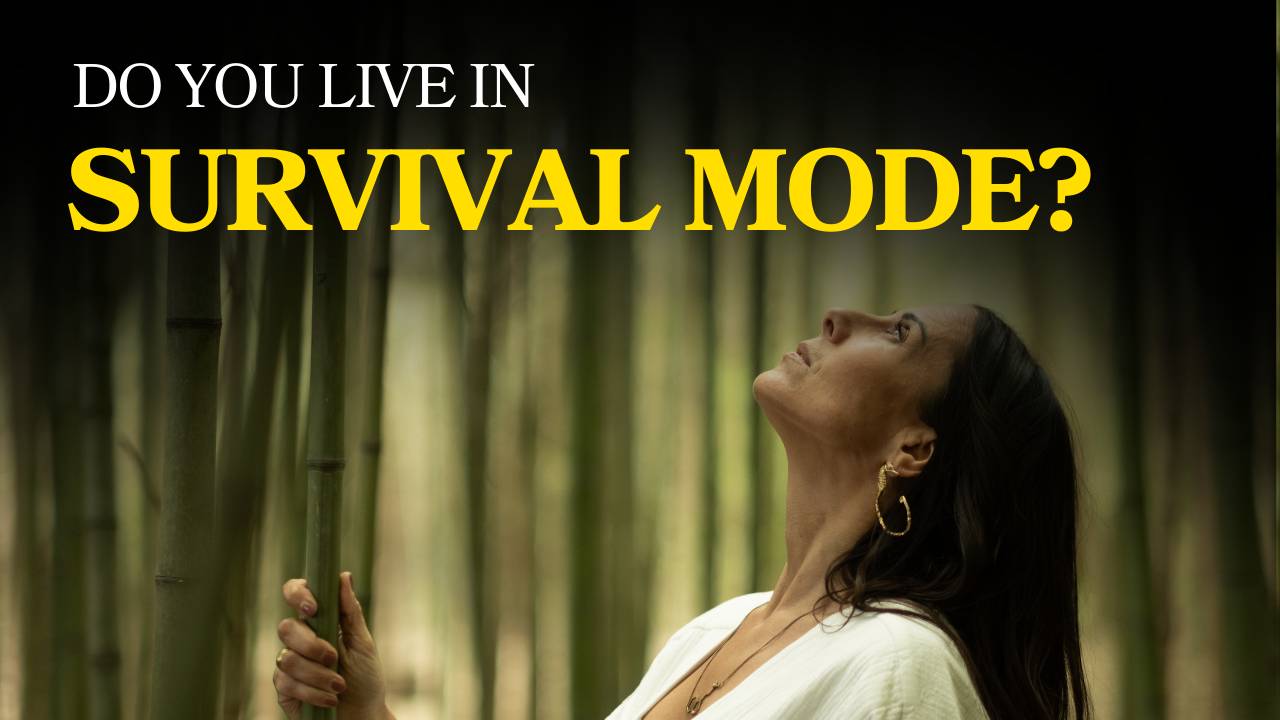
Do You Live in Survival Mode?
There are people who look calm on the outside.
They work, relate, function, smile.
And yet, inside, something never quite settles.
If this resonates, I want to start by saying something clearly:
this is not a personal failure, a lack of will, or a mindset problem.
Very often, it is the body doing exactly what it learned to do in order to survive.
What survival mode really means
Survival mode is not a dramatic state.
It does not always look like panic, fear, or collapse.
More often, it looks like being constantly alert.
- Like holding tension without noticing.
- Like reacting faster than thinking.
- Like needing control to feel okay.
- Like feeling tired even when life seems stable.
Survival mode is what happens when the nervous system learned, at some point, that the world was not safe enough.
And once that lesson is learned deeply, the body does not forget easily.
When the danger is over, but the body doesn’t know it
Trauma is not defined only by what happened.
It is defined by how the body experienced it.
For some people, this comes from sexual abuse.
For others, emotional neglect, violence, constant instability, or living in an environment where boundaries were crossed again and again.
When something overwhelming happens and there is no way to escape, the nervous system adapts.
It becomes faster. Sharper. More vigilant.
This adaptation is intelligent.
It keeps the person alive.
The difficulty begins when the situation changes, but the nervous system stays in the same mode.
The mind may know that the danger is over.
The body often does not.
How survival mode shows up in everyday life
Many people do not recognise survival mode because it has become normal.
It can show up as:
- Feeling tense even during rest
- Difficulty relaxing or sleeping deeply
- Being easily overwhelmed by small things
- Emotional reactions that feel stronger than the situation
- Alternating between high energy and complete exhaustion
- Numbness, disconnection, or a sense of being “far away”
- Trouble trusting others, even when there is no clear reason
- Avoiding closeness or intimacy
- Digestive issues, chronic fatigue, muscle tension
These are not random symptoms.
They are signals.
The nervous system is still prioritising protection over connection.
The body’s logic is different from the mind’s
The nervous system does not operate through reasoning.
- It operates through pattern recognition.
- If the body learned that closeness led to harm, it may react to intimacy as a threat.
- If expression led to punishment, it may shut down emotions automatically.
- If unpredictability was constant, the system may stay hyper-alert at all times.
This happens without conscious choice.
People often say:
- “I don’t know why I react like this.”
- “I know this doesn’t make sense.”
- “I tell myself I’m safe, but it doesn’t change anything.”
That is because the body is not listening to words.
It is responding to memory held at a deeper level.
Survival mode is not who you are
This is an important distinction.
Living in survival mode does not mean that something is wrong with you.
It means that something happened, and your system adapted.
What we often label as anxiety, control, avoidance, or emotional distance are frequently survival strategies that worked once.
They may no longer be serving you now, but they were not created by mistake.
Seeing this changes the entire relationship with yourself.
Instead of fighting the body, judging it, or trying to force it to relax, there is an opportunity to listen.
Hyperactivation and shutdown
Survival mode does not look the same for everyone.
- Some nervous systems remain in hyperactivation.
- Always alert. Always scanning. Always preparing.
- Others move into shutdown.
- Low energy. Disconnection. Emotional numbness.
Many people move between the two.
High functioning followed by collapse.
Intensity followed by emptiness.
Neither state is wrong.
Both are protective.
The system is constantly trying to regulate, even if it does not feel that way.
Why understanding matters
Without understanding, people often turn against themselves.
They believe they are broken.
Too sensitive. Too much. Not enough.
Lazy. Cold. Overreactive. Difficult.
Understanding survival mode changes the question from
“What is wrong with me?” to
“What did my body learn, and why?”
This shift creates space.
And space is where regulation begins.
Not through force.
Not through control.
But through recognition.
Living beyond survival
Living beyond survival mode does not mean never feeling fear, stress, or discomfort again.
It means the nervous system begins to experience safety more often.
- Moments of rest become possible.
- Connection does not always feel threatening.
- Presence becomes accessible.
This is not a quick process.
And it is not something that can be rushed.
The body needs time, consistency, and experiences that gently contradict what it learned before.
A space for reflection
As you read this, you might notice certain patterns in yourself.
Or you might feel resistance, distance, or nothing at all.
All of these responses are welcome.
You do not need to label yourself.
You do not need to decide anything.
This is simply an invitation to notice.
- When do I feel most on edge?
- When do I feel least present in my body?
- What situations make me tighten without real reason?
There are no right answers here.
Awareness alone already begins to shift the system.
If you recognise yourself in survival mode, know this:
your body has been working very hard for a very long time.
It learned how to protect you when protection was necessary.
Learning how to feel safe again is not about undoing that intelligence.
It is about teaching the system that it no longer has to do this alone.
And that begins, quietly, with understanding.
Stay connected with news and updates!
Join our mailing list to receive the latest news and updates from our team.
Don't worry, your information will not be shared.
